
Laundry management
Every garment tracked. Every cycle recorded.
Organisations that issue workwear, PPE or uniforms face a recurring problem: garments move between people, laundry services and return points, and the system of record is usually a spreadsheet or nothing at all. FP Trax gives every garment a digital identity and logs every delivery, collection and return against the right employee. You always know where each item is, who has it and when it was last handled.
Common issue: Most laundry service providers track garments while they are at their facility. Most organisations track what they issued at the start of the programme. Neither party has reliable visibility of what happens in between: who collected which garments, when they were returned, whether they came back at all. The result is accumulated uncertainty that shows up as unexplained losses at year end.
FP Trax closes the gap. Every delivery to a locker is logged. Every collection is confirmed with a QR scan or PIN. Every return is recorded when garments reach the return unit. The laundry service and the organisation share a single source of truth about where every garment is, at every stage of the cycle.
Track your assets - Try 30 days for free
Create account. → Download the mobile app. → Track of what is important to you.
Try 30 days, no credit card or strings attached.
What FP Trax tracks across the laundry cycle
- Full lifecycle visibility: every garment from issue to retirement
- Automatic employee notifications when clean garments arrive
- Proof of collection via QR code or PIN at the locker
- Compliance ready: every handover documented for audit and ISO reporting
- Garment history on demand: every event tied to a person and a date
How the laundry flow works with FP Trax
Six steps. One system. Every garment accounted for.
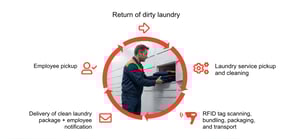
New workwear is imported into FP Trax via a file containing each garment's RFID tag, item type and assigned employee. FP Trax creates a digital record for each garment and marks it as ready for delivery. Nothing enters circulation without a record.
The distributor scans the RFID tags and groups garments into a delivery bundle. FP Trax assigns the bundle to the correct locker slot and generates a printed label. The locker slot is reserved for the recipient and cannot be allocated to anyone else.
The distributor loads the locker using the delivery label. FP Trax logs the delivery and immediately sends the employee a notification with their collection code. The status updates to reflect that the garments are in the locker.
The employee uses the QR code or PIN from the notification to open the locker. FP Trax records the collection against their name and the exact time of pickup. The locker is released and the slot becomes available again.
When the employee is ready to return worn garments, they deposit them in the designated return unit. FP Trax updates the status to confirm the items are back in the laundry cycle and awaiting collection by the distributor.
When a garment reaches the end of its working life, the distributor scans the RFID and marks it as scrapped in FP Trax. If an employee leaves or changes role, the garment can be reassigned to a new recipient and return to the cycle from step one.
Schedule a meeting with our experts.
Workwear tracking and laundry management
Managing workwear at scale is harder than it looks. When an organisation issues hundreds or thousands of garments to employees across a facility, the tracking challenge begins immediately. Who received which items? When were they last cleaned? Were they returned? Have they been replaced since they were issued? Without a system, these questions are answered by memory, physical checks or manual spreadsheets that go out of date within days.
FP Trax treats workwear the same way it treats any other tracked item: every garment gets a unique identity, every movement is logged, and every handover is recorded against a person. The system works with garments with RFID tags and smart lockers to create a fully documented cycle from the moment a new item is registered to the day it is retired. Nothing moves without a record.
The delivery flow is built around smart lockers, which remove the need for the employee and the distributor to be in the same place at the same time. Clean garments are loaded into a reserved locker slot, the employee receives an automatic notification, and they collect using a QR code or PIN at a time that suits them. FP Trax records every step: when the locker was loaded, when it was opened, who collected, and when the slot was closed. Collection proof is available on demand for any delivery.
The return flow is equally important. When employees return worn garments to a dedicated return unit, FP Trax updates the status and keeps the record live. The distributor can see exactly which items are waiting to be collected and cleaned, and the organisation can see which garments are currently in use, in transit, in laundry or in a locker. At any point in the cycle, a single search returns the full history of any individual garment.
For organisations with compliance or audit requirements around workwear, this level of documentation is directly useful. Knowing that item number 4821 was issued to a specific employee on a specific date, cleaned four times, and returned for retirement on another date is exactly the kind of record that manual processes cannot reliably produce. FP Trax generates it automatically as a byproduct of normal operation.
Garment lifecycle management also has a financial dimension. Organisations that cannot track their workwear inventory tend to overorder to compensate for uncertainty. When every item is accounted for, purchasing decisions become data driven. You buy replacements when garments are actually scrapped, not when you suspect they might have disappeared. The reduction in unnecessary stock is a direct cost saving.
The financial impact of untracked workwear is rarely visible until the end of the year, when replacement orders are placed and the true cost becomes apparent. For large industrial organisations issuing workwear to several thousand employees, the annual cost of garments that were never returned, were assigned to the wrong person or simply could not be located can run to six figures or more. These losses do not come from significant individual incidents. They accumulate quietly across thousands of small handovers that were never recorded. FP Trax makes every one of those handovers visible.
There is also a sustainability dimension. Organisations that can document the actual usage history of each garment are better placed to extend its working life. When replacements are ordered because a garment is genuinely worn out rather than because it is unaccounted for, the environmental impact is directly reduced. Fewer replacements means less production, less transport and less waste. Laundry providers using FP Trax can also optimise wash cycles based on actual usage data rather than fixed schedules, which reduces water and energy consumption per garment over its lifetime.
Laundry service providers face a particular version of the visibility problem. They track garments while they are in their facility, but lose visibility the moment items leave for the client site. FP Trax fills that gap, giving both the provider and the client a shared real-time view of every garment in the programme. Providers can position FP Trax as a value added service, strengthen client relationships and reduce the disputes that arise from undocumented losses.
FP Trax supports organisations that manage workwear in house as well as those that work with third party laundry service providers. The system can handle the full cycle regardless of whether the cleaning is done on site or by an external provider. All the distributor needs is access to the FP Trax interface at the locker terminal to scan, load and confirm. The rest is automatic.
Industries where workwear tracking is most critical include manufacturing, logistics, food production, healthcare, hospitality and any environment where employees are required to wear standardised PPE or uniforms. In each of these contexts, the challenges are similar: large numbers of garments, high turnover of employees and limited visibility into the actual state of the inventory. FP Trax addresses all three.
Integration with HR and employee management systems means that garments can be automatically reassigned when someone leaves or changes role. Garments assigned to employees who are no longer with the organisation can be flagged, retrieved and returned to circulation without manual intervention. The system maintains a clean record even when the workforce changes frequently.
FP Trax is built by Francotyp-Postalia, a company that has worked in mailroom and item handling environments for nearly a century. The laundry management capability sits alongside parcel tracking, asset management, letter tracking and smart locker software as part of the FP Trax platform, so organisations that need more than one capability can run everything from the same system with the same interface and the same audit trail.
SERVICE VIDEO
Showcase your awesome service with quality video content.
Lorem ipsum dolor sit amet, consetetur sadipscing elitr, sed diam nonumy
27K | 1.2MIO |
| Lorem ipsum dolor sit amet, consetetur sadipscing elitr, sed diam sit amet, consetetur elitr. | Lorem ipsum dolor sit amet, consetetur sadipscing elitr, sed diam sit amet, consetetur elitr. |